Promo code APP3 – € 3 discount on your first order in app
  Free delivery for orders over € 49


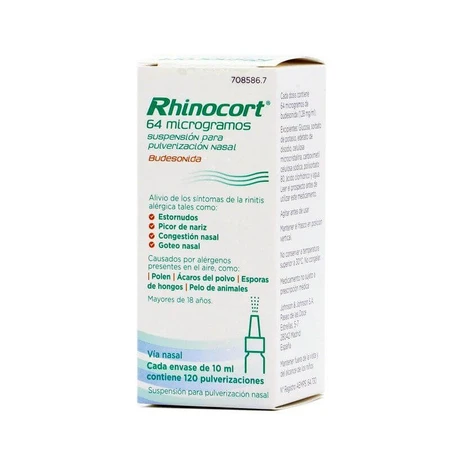


RHINOCORT 64 MCG/PULSE NASAL NEBULIZER 120 DOSES
Description
ACTION AND MECHANISM
A glucocorticoid with anti-inflammatory and anti-allergic properties. Although the exact mechanism of action of glucocorticoids in rhinitis is not fully understood, it appears that both actions are linked to the ability of glucocorticoids to reduce the synthesis and release of inflammatory and allergic mediators, such as histamine, prostaglandins, and leukotrienes, substances responsible for triggering and maintaining nasal symptoms (sneezing, itching, rhinorrhea, and nasal congestion). Glucocorticoids inhibit the initial phase of the allergic reaction mediated by IgE and mast cells, as well as the migration of inflammatory cells to the nasal tissue. Furthermore, like other inhaled glucocorticoids, budesonide reduces the number of eosinophils and bronchial reactivity. The intrinsic potency of budesonide, measured as affinity for the glucocorticoid receptor, is approximately 15 times that of prednisolone.
SENIORS
The safety and efficacy of nasal corticosteroids in the elderly have not been established; however, no specific geriatric problems are anticipated that would limit the usefulness of these medications in this population. Use with caution.
PATIENT ADVICE
- Periodic medical check-ups are recommended during prolonged treatments (several months) to evaluate the effectiveness of the treatment and/or diagnose any changes in the nasal passages (infection, atrophy of the nasal mucosa, perforation, nosebleeds, etc.). - The therapeutic effect is not immediate. Generally, the maximum effect is evident after several days of uninterrupted treatment, especially in severe rhinitis. - Its effectiveness is greater with regular use. - Clean the nose before administration. If nasal congestion is present, a decongestant may be used to facilitate penetration, noting that adrenergic decongestants applied for more than 3-5 days may cause rebound congestion. - Patients with frequent nosebleeds should inform their doctor.
CONTRAINDICATIONS
- [ALLERGY TO CORTICOSTEROIDS] or to any of the excipients contained in the formulation.- Untreated localized infection affecting the nasal mucosa.
PREGNANCY
FDA Pregnancy Category C. Animal studies using large doses of systemic corticosteroids have shown teratogenic, fetotoxic, and embryocidal effects (abnormalities in fetal development, such as decreased body weight and delayed ossification, and malformations such as cleft palate, etc.). There are no adequate and well-controlled studies in humans with intranasal budesonide. Human studies with systemic corticosteroids have not been able to confirm the teratogenicity observed in animals. Infants born to mothers who received large doses of corticosteroids during pregnancy should be carefully examined for signs of adrenal insufficiency. Topical nasal administration of these corticosteroids at the recommended doses does not appear to produce significant systemic levels. During pregnancy, there is a natural increase in the production of endogenous corticosteroids; therefore, pregnant women will require a lower exogenous dose of corticosteroids, and many will not even need corticosteroid treatment during pregnancy. The use of these medications is only acceptable in the absence of safer therapeutic alternatives.
PHARMACOKINETICS
- Absorption: It is rapidly absorbed through the nasal mucosa. Part of the dose is swallowed. The systemic bioavailability of budesonide administered as a nasal suspension, relative to the dosed amount, is 33%. In adults, the maximum plasma concentration after administration of 256 mg of budesonide nasal spray suspension is 0.64 nmol/L and is reached at 0.7 hours. The area under the curve (AUC) after administration of 256 mg of budesonide nasal spray suspension is 2.7 nmol/L in adults and 5.5 nmol/L in children, indicating higher systemic exposure in children. - Distribution: The volume of distribution of budesonide is approximately 3 L/kg. Plasma protein binding ranges from 85-90%. Budesonide pharmacokinetics are dose-proportional within the dose range of 64 to 256 micrograms daily. Metabolism: Budesonide undergoes a high degree of biotransformation (~90%) in the liver, resulting in metabolites with low glucocorticoid activity. The glucocorticoid activity of the main metabolites, 6β-hydroxybudesonide and 16α-hydroxyprednisolone, is less than 1% of that of budesonide. Budesonide metabolism is primarily mediated by CYP3A, a cytochrome P450 subfamily. Budesonide is not metabolized locally in the nasal mucosa. Elimination: Budesonide has high hepatic clearance (approximately 1.2 L/min) and its elimination half-life after IV administration ranges from 2 to 4 hours. Unchanged budesonide is not detected in urine. The metabolites are excreted, either unchanged or in their conjugated form, primarily via the kidneys (70%), although with significantly reduced glucocorticoid activity compared to the parent compound. Therefore, dose adjustment is not considered necessary in patients with renal impairment. The remaining inactive metabolites are eliminated in the feces. The onset of action may occur within 24 hours, although the maximum therapeutic effect is usually delayed for several days.
INDICATIONS
- Symptomatic treatment of [SEASONAL ALLERGIC RHINITIS], [PERENNIAL ALLERGIC RHINITIS] or [VASOMOTOR RHINITIS] in adults and children from 6 years of age.- [NASAL POLYPS]. Symptomatic treatment of nasal polyps in adults, and prevention of the same after polypectomy.
LACTATION
It is unknown whether this drug is excreted in breast milk. Although other systemic corticosteroids are excreted and can inhibit growth, interfere with endogenous corticosteroid production, and produce other adverse effects in the infant, topical nasal administration of these corticosteroids at the recommended doses does not appear to produce significant systemic levels, and therefore, the expected concentrations in breast milk will also not be significant. Use with caution.
CHILDREN
The safety and efficacy of nasal budesonide in children under 6 years of age have not been established. Experience in children aged 6 to 17 years is limited. In a 4-week study involving 406 patients aged 6 to 73 years, no statistically significant differences were observed in ACTH-stimulated cortisol levels from baseline to post-treatment when comparing active treatment with placebo. In another 3-week study involving 318 patients aged 12 to 67 years, no significant differences were found in urinary cortisol levels compared with placebo. In cases of significant systemic absorption of nasal corticosteroids, adrenal suppression and growth retardation may occur in children; however, these effects have not been demonstrated with usual doses of other nasal corticosteroids. The results obtained in a one-year study that included 313 patients aged 6 to 17 years, along with data obtained with other budesonide formulations, allow us to conclude that there is a measurable effect on growth in children, which is why their height should be monitored periodically. This drug may be a useful therapeutic alternative to oral corticosteroids in children 6 years of age and older with seasonal rhinitis, since the intranasal route is associated with a decrease in systemic adverse effects. Its use is accepted in children 6 years of age and older; strict monitoring of children's growth and development is recommended during prolonged treatment.
GUIDELINES FOR PROPER ADMINISTRATION
The total daily dose can be administered in one or two doses (morning or morning and evening). 64 mcg presentation: Shake the container and press the pump several times (5-10 times) until a uniform spray of the product begins. If not used daily, the pump must be recharged. In this case, a single press into the air will suffice. Before application, thoroughly clean both nostrils, shake the container, remove the brown cap, and holding it upright, insert the applicator into one nostril and release the indicated doses. Repeat the process in the other nostril. Replace the cap. It is advisable to regularly clean the plastic parts. To do this, remove the brown cap and the white nasal applicator, then wash them with warm water and allow them to dry completely before replacing them.
POSOLOGY
a) Seasonal allergic rhinitis, perennial allergic rhinitis, vasomotor rhinitis: - Adults and children over 6 years of age (nasal): depending on the presentation, 64 or 100 mcg every 12 hours (morning and evening) in each nostril or 128 or 200 mcg every 24 hours (morning) in each nostril. Maintenance: 64 or 100 mcg every 24 hours (morning) or 50 mcg every 12 hours (minimum effective dose). Symptoms usually disappear after several days of treatment, in some cases after a couple of weeks. Discontinue treatment if there is improvement within 3 weeks. In perennial allergic rhinitis, once symptom control is achieved, gradually reduce the dose every 2-4 weeks until a maintenance dose is established. The "Aqua" presentation is a nasal spray containing budesonide in aqueous suspension, administered without the need for propellant. Treatment of seasonal rhinitis should be initiated, whenever possible, before exposure to the allergen. b) Nasal polyposis/prevention after polypectomy (64 mcg/dose presentation): - Adults and children over 6 years of age (nasal): 128 mcg (2 sprays)/24 hours (in the morning) in each nostril or 64 mcg (1 spray)/12 hours (morning and evening) in each nostril. Once the desired clinical effects have been achieved, the maintenance dose should be reduced to the minimum necessary to control symptoms.
PRECAUTIONS
Caution is advised in cases of: - Pulmonary tuberculosis, fungal or viral respiratory infections. Budesonide should only be administered to patients with active or dormant tuberculosis, untreated systemic fungal, bacterial, or viral infections, or ocular herpes simplex after careful evaluation. If a localized fungal infection of the nasopharynx develops during treatment with nasal budesonide, discontinuation of treatment should be considered. Nasal budesonide treatment may mask an underlying local infection. - In prolonged treatments, the nasal mucosa should be inspected at least once a year. Cases of nasal mucosal alteration and, more rarely, nasal septum perforation, as well as increased intraocular pressure, have been reported following the use of nasal corticosteroids. Administration should be discontinued in the event of nasal surgery or nasal trauma until healing has occurred. Occasionally, concomitant administration of an antihistamine may be necessary to improve ocular symptoms caused by the allergy. Maximum effects are obtained after several days of treatment. The use of excessive doses or long-term treatment with nasal glucocorticoids may trigger signs or symptoms of hyperadrenocorticism, suppression of the hypothalamic-pituitary-adrenal axis, and/or growth suppression in children. Special caution is advised in patients previously treated with systemic steroids, as switching to nasal budesonide administration may trigger adrenal insufficiency. In this case, systemic administration should be restarted, and the necessary supportive measures should be implemented, especially if additional stressful situations such as surgery, systemic infection, etc., are present. Additionally, some patients may initially experience withdrawal symptoms such as joint and/or muscle pain, fatigue, and depression. Avoid contact of the product with the eyes. If contact occurs, rinse eyes immediately with plenty of water.
ADVERSE REACTIONS
The adverse effects of this medication are generally mild and transient. The most frequent adverse effects are:
- Ear, nose, and throat: [NASAL IRRITATION] (3-9%), [SNEEZING], immediate sneezing fits. In both cases, the incidence was similar to placebo and was related to the drug and/or the vehicle of the preparation. Occasionally, [NASAL CONGESTION], [EPISTAXIS] (3-9%), [RHINORRHEA], [NASAL DRYNESS]. Rarely, [NASAL CANDIDIASIS], [PHARYNGEAL CANDIDIASIS] (<1%). Exceptionally, after several months of treatment, ulceration of the nasal mucosa and [PERFORATION OF THE NASAL SEPTUM]. Cases of [DYSGEUSIA] and [PAROSMIA] have been reported.
- Allergic/dermatological: rarely, [URTICARIA], [BRONCHIAL SPASM], [ANGIOEDEMA], [EXANTHEMATOUS ERUPTIONS], [HERPESVIRUS SIMPLEX INFECTION].
- Neurological/psychological: rarely, [NERVOUSNESS].
- Ocular: Rarely, after prolonged use, increased intraocular pressure, [CATARACTS] and [GLAUCOMA].
- Respiratory: [PHARYNGITIS], [COUGH](3-9%). [DYSPNEA] and [HOARSENESS] (<1%).
- Digestive: [DYSPEPSIA], [DRY MOUTH] (1-3%), [NAUSEA] (<1%).
- Musculoskeletal (<1%): [MYALGIA], [MUSCULOSKELETAL PAIN].
If the recommended doses are exceeded for prolonged periods or in particularly predisposed individuals, symptoms of hypercorticism may appear.
Treatment should be discontinued in case of persistent nasopharyngeal irritation.
Features
| Product code | 585445 |
| Category | Ophthalmology, Medical Equipment and Medical Supplies, Useful kits, Focused Ads (IT) |
| Quantity | 120 |
| Delivery from | Spain |
RHINOCORT 64 MCG/PULSE NASAL NEBULIZER 120 DOSES
RHINOCORT 64 MCG/PULSE NASAL NEBULIZER 120 DOSES
Delivery from Spain

 24 Aug - 2 Sep

 Guaranteed delivery from Spain: 24 August - 2 September
-
 Autoship & Save
- Enjoy 5% discount on your order
- Repeat deliveries can save you up to € 9,48 / year
- Skip, change or cancel anytime¹
 RHINOCORT 64 MCG/PULSE NASAL NEBULIZER 120 DOSES€ 15,90 € 15,11Save € 0,79 with Autoship & SaveQuantity:
 -
 Pay securely with your preferred payment method













Recently viewed products







Reviews

RHINOCORT 64 MCG/PULSE NASAL NEBULIZER 120 DOSES
 Earn € 1 Reward for every review
- For each submitted and approved review you can earn € 1 Reward on your Rewards Credit.
- Rewards are given once for each purchased product you have reviewed.
- You have to be authorised to receive Rewards
All reviews

There are no reviews for this product.











 Description