Promo code APP3 – € 3 discount on your first order in app
  Free delivery for orders over € 49


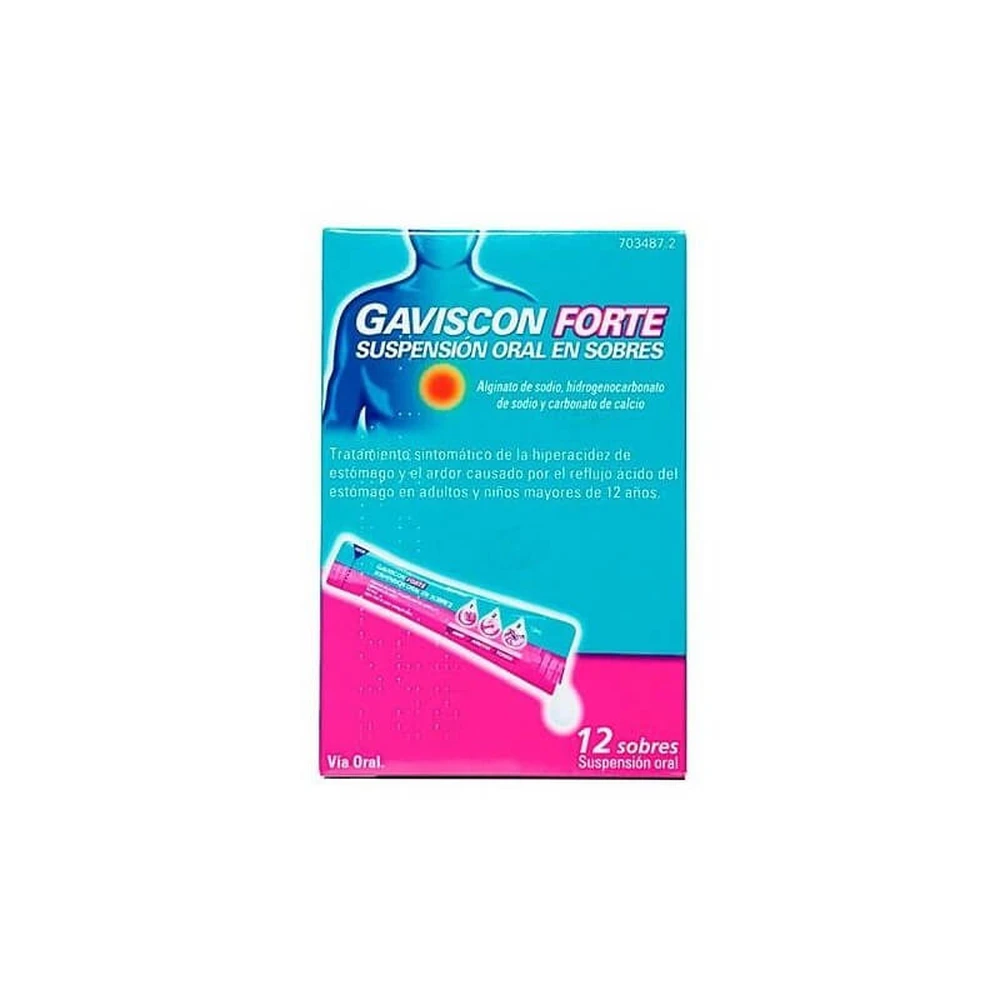
Gaviscon 32 mint-flavored chewable tablets
Description
Instructions
- [GASTRIC HYPERACIDITY]. Symptomatic treatment of stomach hyperacidity and heartburn caused by acid reflux from the stomach.
Posology
- Adults, oral route: 10
- 20 ml (measured with the measuring cup, or 1 or 2 sachets of 10 ml each), or 2 to 4 chewable tablets, as needed.
- Children, oral route:
Adolescents >= 12 years: see adults.
Children < 12 years: not recommended, except under better medical advice.
As with all antacids, if symptoms persist for more than 7 days despite continued treatment, the clinical situation should be evaluated.
Guidelines for proper administration
- Oral administration, preferably after meals and before bedtime.
- It should not be taken with large amounts of milk or dairy products because (due to its calcium antacid content) it can cause increased blood calcium levels and milk-alkali syndrome (Burnett's syndrome).
- Because it can interfere with some medications, you should wait 2 hours after taking Gaviscon before taking any other oral medication. If you have already taken another medication, you should wait 1-2 hours before taking Gaviscon to obtain the maximum benefit from that other medication.
* If using the suspension bottle, use the measuring cup to measure the amount to take and drink directly. Wash the measuring cup after each use.
* In the case of envelopes, take directly from the envelope.
* In the case of tablets, chew.
Contraindications
- Hypersensitivity to any component of the medication.
- Severe renal insufficiency (CLcr < 30 ml/min).
- [HYPERCALCEMIA] or conditions that cause hypercalcemia
- History of [HYPOPHOSPHATEMIA]
- Nephrolithiasis due to calcium [KIDNEY STONES].
Precautions
- [KIDNEY STONES]. Avoid prolonged use as it increases the risk of developing kidney stones.
- [HYPERCALCEMIA]. Administration of high doses for prolonged periods may produce undesirable effects such as hypercalcemia and milk-alkali syndrome, especially in patients with renal impairment. The medication should not be administered with large quantities of milk or dairy products.
- [HYPERCALCIURIA]. It should not be administered to these patients.
- [RENAL INSUFFICIENCY]. Administration is not recommended in patients with severe renal insufficiency (CrCl <30 ml/min). If administered for prolonged periods in patients with CrCl ≥ 30 ml/min, plasma calcium, phosphate, and magnesium levels should be monitored regularly.
- In general, antacids containing calcium should not be administered to patients with [CONSTIPATION], [HEMORRHOIDS] and [SARCOIDOSIS], except under better medical judgment.
- Patients with very low levels of gastric acid. There is a possibility of reduced effectiveness in these patients.
- Isolated cases of a possible relationship between calcium carbonate, [APPENDICITIS], [GASTROINTESTINAL HEMORRHAGE], [INTESTINAL OBSTRUCTION], or [EDEMA] have been described in the literature.
Warnings about excipients:
This medicine contains sodium salts. For the exact sodium content, please refer to the composition. Oral and parenteral dosage forms with sodium amounts exceeding 1 mmol (23 mg)/maximum daily dose should be used with caution in patients on sodium-restricted diets.
Warnings about excipients:
This medicine contains aspartame as an excipient, which should be taken into account by people with phenylketonuria. 100 mg of aspartame corresponds to 56.13 mg of phenylalanine.
Interactions
- Digitalis (digoxin, digitoxin): there are studies with some antacids (algeldrate, magnesium hydroxide) in which a decrease in the absorption of digitalis has been recorded, so it is recommended to space its administration 2 or 3 h.
- Erlotinib: possible reduction in erlotinib levels due to decreased absorption. Antacids increase gastric pH, which could decrease erlotinib solubility, absorption, and therapeutic effects. It is recommended to administer antacids at least 4 hours before or 2 hours after the daily dose of the antineoplastic agent.
- Gabapentin: A slight decrease in gabapentin levels has been observed when administered concurrently with or within 2 hours of taking other antacids, due to an increase in pH. It is recommended to administer gabapentin 2 hours before an antacid.
- Quinolones (ciprofloxacin, norfloxacin): there are studies with some antacids (algeldrate, almagate) in which a decrease in their absorption has been recorded due to the formation of insoluble complexes that are not absorbed at the intestinal level, so it is recommended to separate their administration by 2 or 3 hours.
- Iron salts (citrate, fumarate, iron sulfate): there are studies with some antacids (algeldrate, magnesium trisilicate) in which a decrease in absorption has been recorded due to the formation of poorly soluble complexes, so it is recommended to space the administration 2 or 3 h.
- Lithium salts (lithium carbonate): there are studies in which a possible increase in its renal excretion with loss of antimanic activity has been recorded, because some of the sodium may be reabsorbed instead of the lithium.
- Tetracyclines (tetracycline): there are studies in which the possible formation of non-absorbable complexes at the gastrointestinal level has been recorded, thus decreasing its absorption, so it is recommended to space the administration 2 or 3 h.
Pregnancy
An open-label, controlled study in 281 pregnant women showed no significant adverse effects of Gaviscon on the course of pregnancy or on the health of the fetus/newborn child. Based on this and previous experience, this medicine can be used during pregnancy. However, given the presence of calcium carbonate, it is recommended to limit the duration of treatment as much as possible and avoid concomitant intake of milk and dairy products to prevent excess calcium, which can trigger milk syndrome.
- alkaline.
Lactation
Acceptable use. Chronic or excessive use is not recommended.
Adverse reactions
- In exceptional cases, allergic reactions such as [URTICARIA] or [BRONCHIAL SPASM] and [ANAPHYLAXIS] have been observed.
- It has also been reported that, due to prolonged use and high doses, metabolic and nutritional disorders such as [HYPERCALCEMIA] and [ALKALOSIS] as well as Burnett syndrome (milk-alkali syndrome) may occur.
Features
| Product code | 585550 |
| Category | Candies and Drops, Snacks, Useful kits |
| Product line | Gaviscon |
| Quantity | 32 |
| Product type | Chewable tablets |
| Flavor | Mint |
| Delivery from | Spain |
Gaviscon 32 mint-flavored chewable tablets
Gaviscon 32 mint-flavored chewable tablets
Delivery from Spain

 24 Aug - 2 Sep

 Guaranteed delivery from Spain: 24 August - 2 September
-
€ 20,30Delivery: € 5,99 (free from € 49)
Delivery from Spain:
24 August - 2 September
-
 Pay securely with your preferred payment method












Recently viewed products
















Reviews

Gaviscon 32 mint-flavored chewable tablets
 Earn € 1 Reward for every review
- For each submitted and approved review you can earn € 1 Reward on your Rewards Credit.
- Rewards are given once for each purchased product you have reviewed.
- You have to be authorised to receive Rewards
All reviews

There are no reviews for this product.









 Description